Reason — The Second of Five Principles
There is no shortage of paths. In any direction a person turns, there is a plan, a method, a philosophy, a program — each one promising results, each one followed by someone for whom it worked. The abundance is not the problem. The problem is that abundance without discernment produces not clarity but noise.
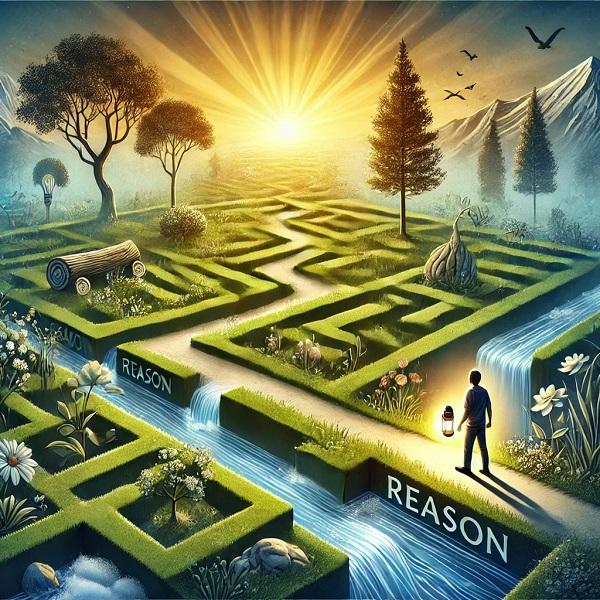
Reason is the mind at its most honest and discerning. It does not dismiss what is available. It asks a quieter and more demanding question — not what has worked, but what is right for this person, at this point, given what is actually true about their situation. It navigates the infinite possibilities of combining thoughts, feelings, nutrition, and movement — and confirms, before anything is set in motion, which combination is genuinely worth pursuing.
But Reason must be wielded by spirit, not passion — for passion alone does not illuminate. It justifies.
In the court of mind, when passions reign,
Love’s tender throne is seized in vain.
Now, passions wield the sword of reason,
Leaving scars in every season.
What is true about one person’s situation is not what is true about another’s. A path chosen because it worked for someone else, followed with sincerity and effort, may produce nothing — not because the effort was insufficient, but because the path was never the right one to begin with. The starting point matters. The metabolic rate, the physical capacity, the particular configuration of thought and feeling and history that makes one person different from every other — these are not obstacles to be overcome. They are the information from which the right path is found.
This is where Reason does its quiet work. It takes what Awareness has revealed — the honest picture of where one actually stands — and examines it. Not coldly. Not mechanically. But with the kind of careful attention that combines what is known, what is felt, and what is genuinely true, and finds within that combination the path that is not merely possible but right.
It reaches into the territory of thoughts and feelings. These are powerful forces — they shape decisions, behaviors, and the way one moves through the world. But without the steadying presence of Reason, they can lead somewhere unintended. A reaction formed in the heat of a negative thought, acted upon before it has been examined, tends to produce consequences that outlast the moment that caused them. Reason examines whether a thought is actually true, finds a more grounded way to move through a feeling rather than be moved by it. And it is not only thoughts and feelings that require this steadying — they are part of a larger system, each element shaping and being shaped by the others.
It reaches into the relationship with food. The options are endless and the noise around them is considerable — diets adopted because they are current, supplements taken because they are recommended, eating patterns followed because someone else found results in them. A particular diet may produce remarkable results in one person and leave another unchanged, or worse. Reason does not evaluate these from the outside. It evaluates them from within the specific reality of the person considering them — what this metabolism requires, what this life can sustain, what will nourish not for a season but for the long course.
It reaches equally into the relationship with movement. A high-intensity program may build capacity and resilience in one person and cause injury in another. Someone returning from physical setback, or someone whose body calls for a gentler approach, requires a different path entirely — not a lesser one, but a different one. Cardio, strength training, flexibility — each serves a distinct purpose, and the combination that serves one person well may not serve another at all. The exercises that produce short-term results are not always the ones that change the body’s metabolism for days or weeks. Reason holds that distinction carefully. It asks not what is effective in general, but what is effective here — for this body, at this level, toward this particular goal.
And it reaches into the less visible territory — the relationship between thoughts, feelings, nutrition, and movement together. These do not exist in isolation from one another. How a person thinks shapes how they feel. How they feel shapes what they reach for when they eat. What they eat shapes the energy available for movement. And how they move shapes, in turn, how they think and feel. Reason understands this interconnection and works within it — not imposing a plan that addresses one element while ignoring the others, but finding the approach that honors all of them together.
The starting point is not a limitation. It is the truth from which everything else begins. From that truth, Reason charts a course — realistic in its goals, deliberate in its steps, and honest enough to return regularly to what the evidence reveals, adjusting where adjustment is needed. Not as a sign of failure, but as the natural movement of a faculty that is genuinely paying attention.
And Reason is what makes that truth useful — turning what Awareness has seen into a path that can actually be walked, and continuing to walk it wisely.”